
- 30 Apr, 2026
-
 by Masoud Hosseini
- Business Strategy
- 0 Comments
S-Corp Owners: 3 Payroll Mistakes That Could Cost You Thousands in Penalties
The Hidden Risks of S-Corp Payroll Management Transitioning your business to an S-Corporation is one of the most effective strategies for high-earning freelancers, real estate investors, and startup founders to optimize their tax liabilities. By allowing business income to pass through directly to your personal tax return, you can legally minimize the heavy burden of self-employment taxes. However, this sophisticated tax structure comes with a strict set of administrative responsibilities; most notably, how you manage your payroll.
For high-value business owners, particularly those navigating the complex tax landscape of San Diego and the broader state of California, payroll is not just an administrative chore; it is a critical compliance checkpoint. A single misstep in how you pay yourself or your employees can trigger severe IRS audits, aggressive penalties, and the revocation of your S-Corp status.
Protecting your wealth requires prudence, proactive planning, and a deep understanding of federal and state tax codes. Below are the three most common payroll mistakes S-Corp owners make, and how you can avoid them to ensure long-term financial peace of mind.
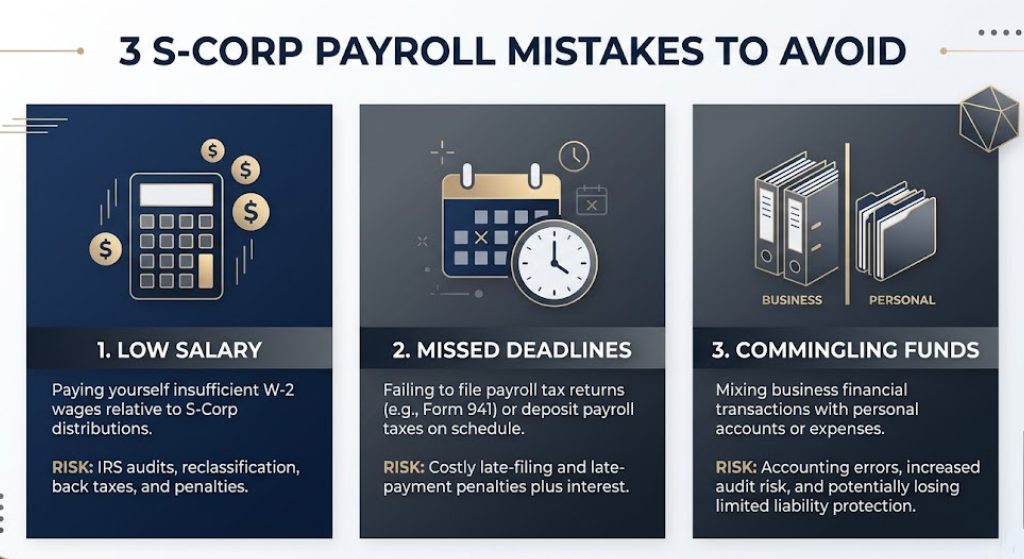
3 S-Corp Payroll Mistakes To Avoid
Mistake 1: Failing to Pay "Reasonable Compensation"
The most heavily audited area for S-Corporations is the division of owner income between W-2 salary and shareholder distributions. Because W-2 wages are subject to Medicare and Social Security taxes, while distributions are not, there is a natural temptation for owners to take a minimal salary and maximize their tax-free distributions.
The IRS is acutely aware of this strategy. To prevent tax evasion, federal law mandates that S-Corp officers who perform services for the corporation must be paid "reasonable compensation" before they can take any non-wage distributions.
The IRS Scrutiny on Shareholder Distributions
If the IRS determines that your salary is artificially low, they have the authority to reclassify your distributions as W-2 wages. This reclassification results in immediate demands for back taxes, failure-to-deposit penalties, and substantial interest charges. What began as an attempt to save a few thousand dollars can quickly escalate into a devastating financial liability.
Determining Your True Market Value Reasonable compensation is not a fixed number; it is heavily dependent on your specific industry, the size of your business, and your geographic location. For instance, a digital agency owner operating in San Diego will have a vastly different reasonable compensation baseline than a consultant in a rural market. Establishing this figure requires careful analysis of market data, your daily operational duties, and the financial health of the business. Documenting this methodology is essential for defending your tax position should your returns ever be reviewed.
Mistake 2: Missing Quarterly Filing Deadlines (IRS and California EDD)
When you operate an S-Corp, you are no longer just a taxpayer; you are a tax collector on behalf of the government. You are required to withhold income taxes, Social Security, and Medicare from your salary, and remit those funds to the appropriate tax authorities on a strict schedule.
Many new S-Corp owners mistakenly believe that tax obligations only occur in April. In reality, payroll compliance is a year-round responsibility. You must file Form 941 on a quarterly basis with the IRS, alongside the necessary filings with California's Employment Development Department (EDD).
The Compounding Cost of Late Deposits Failing to remit payroll taxes on time is one of the most heavily penalized infractions in the tax code. The IRS applies the Trust Fund Recovery Penalty (TFRP), which allows them to hold you personally liable for the unpaid trust fund taxes, piercing the corporate veil that usually protects your personal assets. Furthermore, California's EDD is notoriously aggressive in pursuing late state payroll taxes.
Penalties for late deposits can scale rapidly, from 2% for being just a few days late to 15% if the payment is severely delayed. By the time many business owners realize they have missed a deadline, the accrued penalties and interest can easily outpace the original tax owed. Automating these systems under the guidance of a professional tax advisor is paramount to safeguarding your capital.
Mistake 3: Commingling Personal Expenses and Failing to Reimburse Correctly High-performing business owners frequently blur the lines between personal and business expenses, particularly when covering travel, home office costs, or client entertainment out of their personal accounts. The mistake occurs when owners attempt to reimburse themselves through their standard payroll without a structured system in place.
When you simply add a reimbursement to your W-2 paycheck without proper documentation, the IRS views that money as additional taxable income, subjecting it to the very payroll taxes you are trying to avoid.
The Power of an Accountable Plan To legitimately pull money out of your S-Corp for business expenses without triggering tax liabilities, you must establish an "Accountable Plan." This is a formal reimbursement arrangement that meets strict IRS guidelines regarding business connection, substantiation (receipts and logs), and the timely return of excess amounts.
Implementing an Accountable Plan ensures that your reimbursements remain completely tax-free and are fully deductible for the corporation. It is a vital tool for maximizing your tax efficiency, but it requires disciplined bookkeeping and expert structural setup to withstand regulatory scrutiny.
We Help San Diego S-Corp Owners Avoid Penalties and Optimize Taxes At our firm, we understand that your primary focus should be on scaling your business and serving your clients, not deciphering the intricacies of the IRS tax code. We partner with high-value freelancers, real estate investors, and business owners to provide meticulous, results-oriented tax advisory services.
We help S-Corp owners avoid devastating payroll penalties by ensuring your reasonable salary is accurately calculated, meticulously documented, and fully compliant with both federal and California state regulations. We oversee your quarterly filing schedules and implement efficient tax strategies, such as Accountable Plans, to ensure you keep more of the wealth you work so hard to build.
Our relationship with our clients is built on mutual trust, clear communication, and a shared commitment to financial prudence. We replace the anxiety of compliance with the peace of mind that your financial foundation is secure.

Book Your Free Consultation Do not leave your S-Corp compliance to chance. Let us review your current payroll structure to identify potential liabilities and uncover new opportunities for tax savings.
Book your free consultation today to speak with a dedicated tax advisor and take the first step toward complete financial clarity.
0 Comments
Post a comment