- 14 May, 2026
-
 by Masoud Hosseini
- 0 Comments
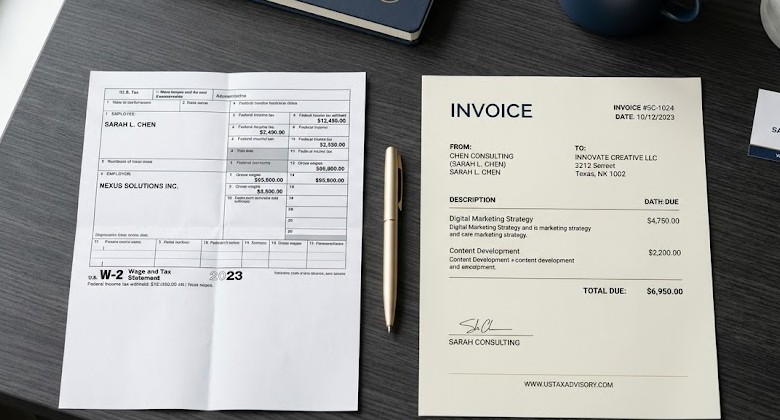
If you are balancing a full-time career with a thriving freelance business or consultancy, you already know that your tax situation is no longer standard. You are likely asking yourself: Am I overpaying on my self-employment taxes? How do I safely manage both W-2 withholdings and 1099 quarterly payments without triggering IRS penalties? This guide is designed to answer those exact questions. At our firm, we specialize strictly in proactive tax strategy for high-earning dual-income professionals and S-Corp owners here in San Diego. We believe in total transparency, empowering you to take personal responsibility for your financial trajectory. The checklist below will bridge the gap between reactive tax filing and strategic wealth protection, ensuring you know exactly where you stand and how to optimize your dual-income structure for the 2026 tax year.
The Dual-Income Dilemma: Balancing W-2 Security with 1099 Complexity
Earning a steady W-2 salary while simultaneously building a robust 1099 income stream is a powerful wealth-building strategy. For many professionals in San Diego, from tech executives consulting on the side to medical professionals with private practices, this dual-income structure offers both stability and limitless earning potential. However, it also introduces a significant layer of financial complexity.
The most common pain point we see among high-earning dual-income professionals is the “surprise” tax bill in April. When you are solely a W-2 employee, your employer handles the burden of tax withholding. The moment you introduce 1099 income, you transition from an employee to a business owner in the eyes of the IRS. You become personally responsible for income taxes, self-employment taxes, and proactive compliance. Without a prudent strategy, dual-income earners frequently face steep underpayment penalties, missed deduction opportunities, and severe cash flow disruptions.
At our firm, we help clients replace uncertainty with clarity. By implementing a proactive tax strategy, we ensure you keep more of your hard-earned money, remain strictly compliant, and achieve true peace of mind. Here is your essential tax planning checklist for 2026.
Your Proactive 2026 Tax Planning Checklist
1. Calculate and Pay Quarterly Estimated Taxes Accurately
When you generate 1099 income, taxes are not automatically withheld from your checks. The IRS operates on a “pay-as-you-go” system, requiring you to make quarterly estimated tax payments if you expect to owe $1,000 or more when your return is filed.
For dual-income earners, calculating these payments requires looking at your total global income. A common mistake is calculating 1099 taxes in a vacuum, ignoring the fact that your W-2 income may push your freelance earnings into a much higher marginal tax bracket. We help our clients project their total annual income, calculate precise quarterly obligations, and schedule payments to avoid costly IRS underpayment penalties.
2. Optimize Your W-2 Withholdings (The W-4 Strategy)
One of the most effective, low-friction strategies for managing dual-income taxes is adjusting the withholdings on your W-2 job. Instead of writing four separate quarterly checks for your 1099 business, you can submit a revised Form W-4 to your employer, instructing them to withhold an additional specific dollar amount from each paycheck.
This approach offers a distinct advantage: the IRS considers W-2 withholdings as being paid evenly throughout the year, regardless of when they are actually withheld. If you realize in November that you are facing a massive tax liability from your freelance work, drastically increasing your W-2 withholdings for the final weeks of the year can help you retroactively avoid underpayment penalties.
3. Evaluate Entity Structuring (When to Consider an S-Corp)
If your 1099 income is growing substantially, operating as a Sole Proprietor may no longer be the most prudent financial decision. As a Sole Proprietor, every dollar of your net freelance income is subject to a 15.3% self-employment tax, in addition to federal and state income taxes.
For clients whose freelance income reaches a certain threshold, we evaluate the transition to an S-Corporation. An S-Corp allows you to separate your business income into a “reasonable salary” (subject to payroll taxes) and owner distributions (exempt from self-employment taxes). We help San Diego business owners navigate this transition safely, ensuring strict compliance with IRS “reasonable salary” guidelines while safely maximizing tax savings.
4. Maximize Dual Retirement Contributions
Having both W-2 and 1099 income opens the door to unique, high-leverage retirement planning opportunities. While you may already be contributing to a 401(k) through your employer, your freelance income allows you to establish a retirement vehicle for your business, such as a SEP IRA or a Solo 401(k).
The rules governing contribution limits across multiple plans are highly specific and require careful calculation. However, correctly utilizing a Solo 401(k) can allow you to shelter tens of thousands of additional dollars from taxation in 2026. We work closely with our clients to determine the optimal contribution limits across both their employee and employer-sponsored plans, focusing on long-term wealth preservation.
5. Maintain Impeccable Expense Documentation
In the realm of 1099 income, meticulous record-keeping is not just good practice; it is your primary defense against overpaying taxes. Every legitimate, ordinary, and necessary business expense reduces your taxable net income.
However, co-mingling personal and business finances is a red flag. We advise all our dual-income clients to establish a dedicated business checking account and a business credit card exclusively for their 1099 activities. From home office deductions to software subscriptions and professional development, maintaining a clean, auditable trail of expenses ensures you capture every deduction you are entitled to without fearing IRS scrutiny.
The Cost of Reactive Tax Preparation
Tax preparation is merely looking in the rearview mirror and reporting what has already happened. By the time April arrives, the window for meaningful tax mitigation has permanently closed. Reactive filing is where penalties accrue, deductions are missed, and financial stress peaks.
Tax planning, on the other hand, is forward-looking. It is the process of mapping out your financial year, anticipating liabilities, and structuring your affairs to yield the most favorable, compliant outcome. For the high-earning freelancer or consultant, settling for a reactive approach means voluntarily leaving money on the table.
Take Control of Your Financial Trajectory
Navigating the intersection of W-2 and 1099 income requires more than generic advice; it demands a tailored, strategic approach built on mutual trust and accountability. Our firm is dedicated strictly to premium tax advisory, helping you eliminate surprises, optimize your cash flow, and achieve total confidence in your financial foundation.
You have worked hard to build your dual-income streams. Let us ensure you keep what is rightfully yours.
Book your free consultation.
0 Comments
Post a comment